Five Ways to Respond to a Young Child’s First Marks
A first mark is already a decision
A toddler drags a broad crayon across paper, watches a line appear, and then taps the same
spot twice. An adult might see a scribble and immediately ask, ‘What is it?’ But the most
useful response often begins one step earlier: notice what happened. The child chose a
direction, applied pressure, and responded to a change they could see. There is no need to
turn that experience into a recognizable picture. Parents and educators can support early art
by making room for attention, repetition, and the child’s own choices.
1. Describe what you actually see
Try a short observation such as, ‘I see a long blue line,’ ‘You made lots of dots,’ or ‘That
mark crosses the other one.’ These phrases show interest without assigning a story the child
did not choose. If the child names the drawing, follow their lead. If they say nothing, silence
is welcome. Descriptive language is especially helpful when adults feel tempted to evaluate
the image as pretty, messy, good, or wrong. Instead of rating the result, we acknowledge the
action and invite curiosity.
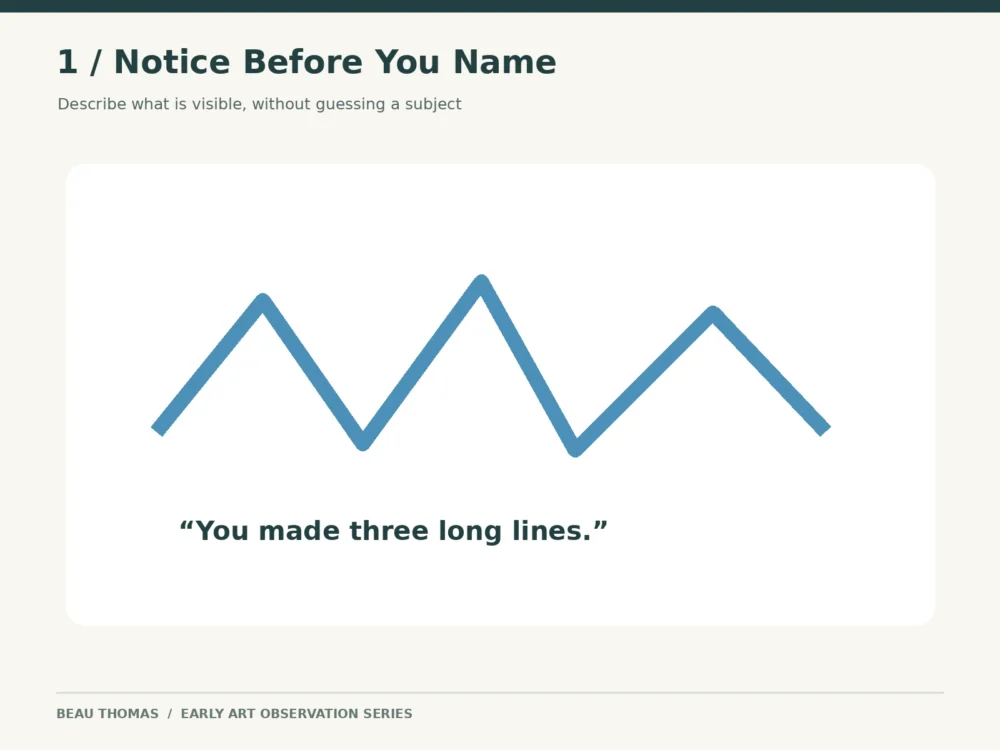
Describe a line’s direction and color without assigning it a subject.
2. Let the materials offer manageable choices
A simple setup can invite more independence than an elaborate craft kit. Offer a sturdy sheet
of paper and one or two suitable mark-making tools. If the child is interested, let them choose
among a few colors, paper positions, or safe tools. The choice should be real, not a hidden
test with one correct answer.
Some children prefer broad sweeping marks; others enjoy small repeated gestures. A child
may explore the paper’s edge, turn it around, or focus on a single patch of color. Those
decisions belong to the maker. Use age-appropriate, washable, nontoxic materials, stay
close, and follow product guidance, including any small-parts or mouthing warnings.
In practice, set the paper on a stable surface where the child can reach comfortably. Remove
distracting objects and offer one fresh possibility at a time. A few minutes is enough for an
invitation: put down the sheet, place the tool within reach, then wait to see what the child
does. If they ignore the tool and explore the paper instead, that observation can guide the
next invitation. For children who find gripping difficult, a larger suitable tool or secured paper
may provide a more comfortable option. Choose adaptations collaboratively rather than
assuming that a particular difficulty determines what a child can make.
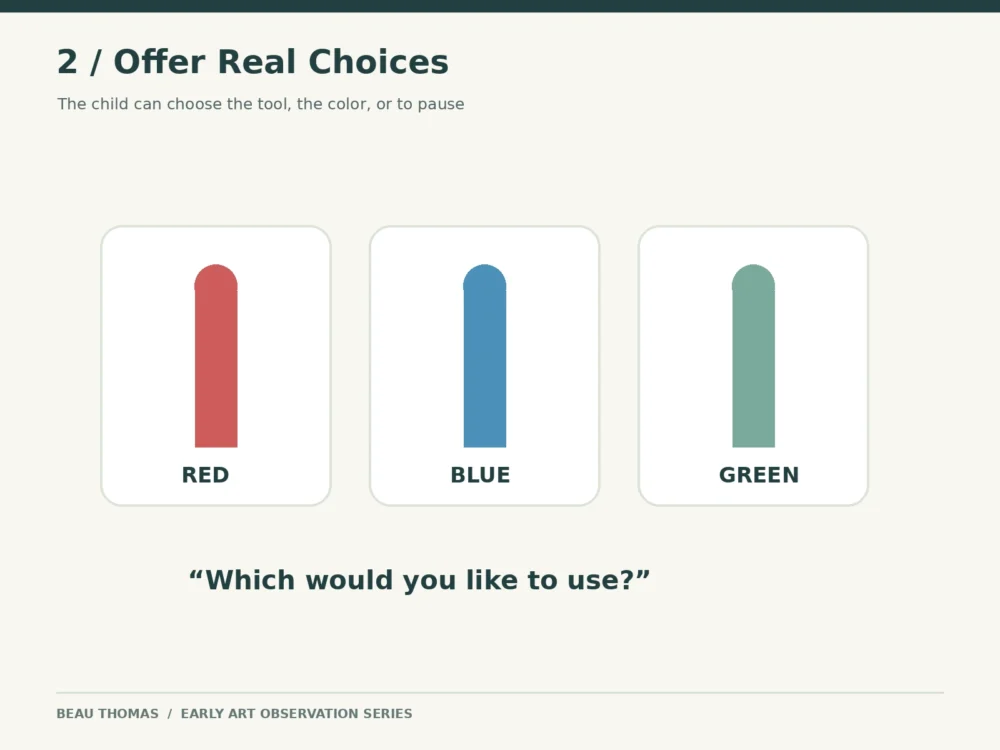
Offer a small selection of safe, appropriate mark-making tools and honor the child’s choice.
3. Ask less, listen more
Questions can be useful, but a running stream of ‘What is that?’ ‘Can you draw a house?’
and ‘What color should this be?’ can quietly replace the child’s exploration with an adult’s
agenda. Try waiting and watching. When a question feels natural, keep it open: ‘Would you
like to tell me about that?’ or ‘What would you like to try next?’ If the child points, repeats a
movement, smiles, or leaves, treat those as meaningful responses without insisting on
spoken explanations. There is no requirement that every image carry a verbal story.
4. Resist the urge to repair the artwork
Adults can find it irresistible to add eyes to a circle, finish an unfinished shape, or ‘show’ the
child how to make the picture clearer. Demonstration has its place, but not every art session
needs one. When the adult changes the child’s page, the final image may communicate the
adult’s preferences more than the child’s discovery. If a demonstration would help, use a
separate sheet and ask whether they want to watch. Do not secretly correct their marks. A
scribble that remains exactly as the child left it preserves something valuable: evidence of
the decisions they actually made.
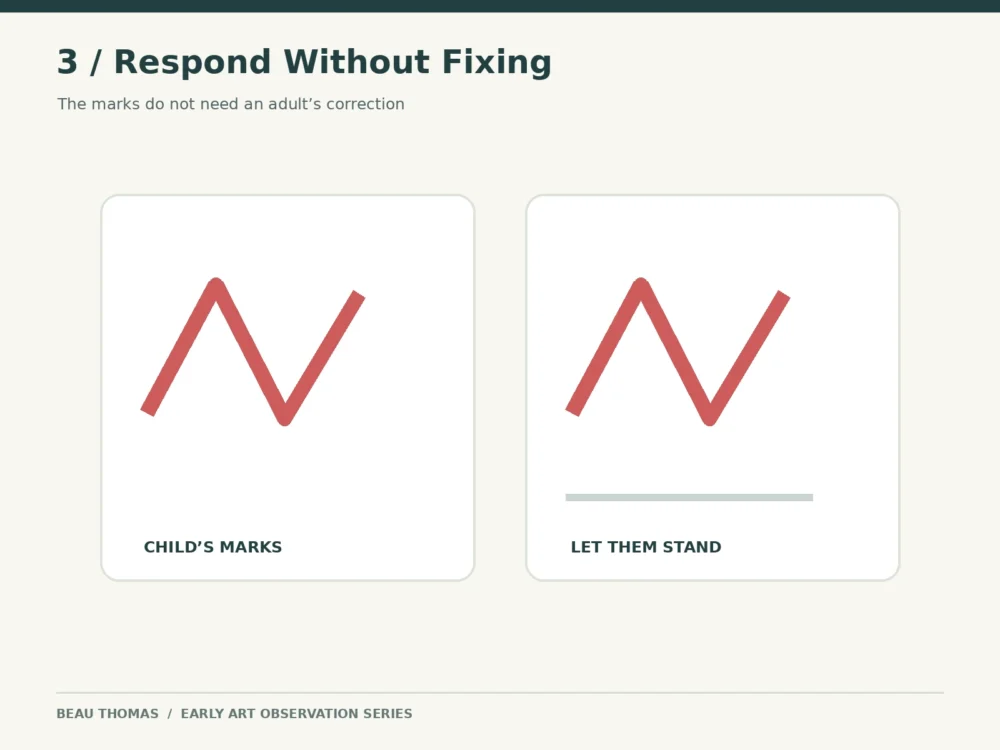
The child’s own marks are complete without an adult ‘repair.’
5. Notice when the child is finished
A young artist may make two marks and walk away. That does not mean the activity failed.
Attention changes, and children communicate readiness in many ways. Offer an invitation to
return later without requiring a completed product. A useful phrase is, ‘We can stop now.
Your picture can stay just like this.’ The same respect applies when a child repeats an action
for longer than an adult expected. Rather than rushing to a more advanced assignment, offer
time, paper, and an inviting space when it is safe and practical.
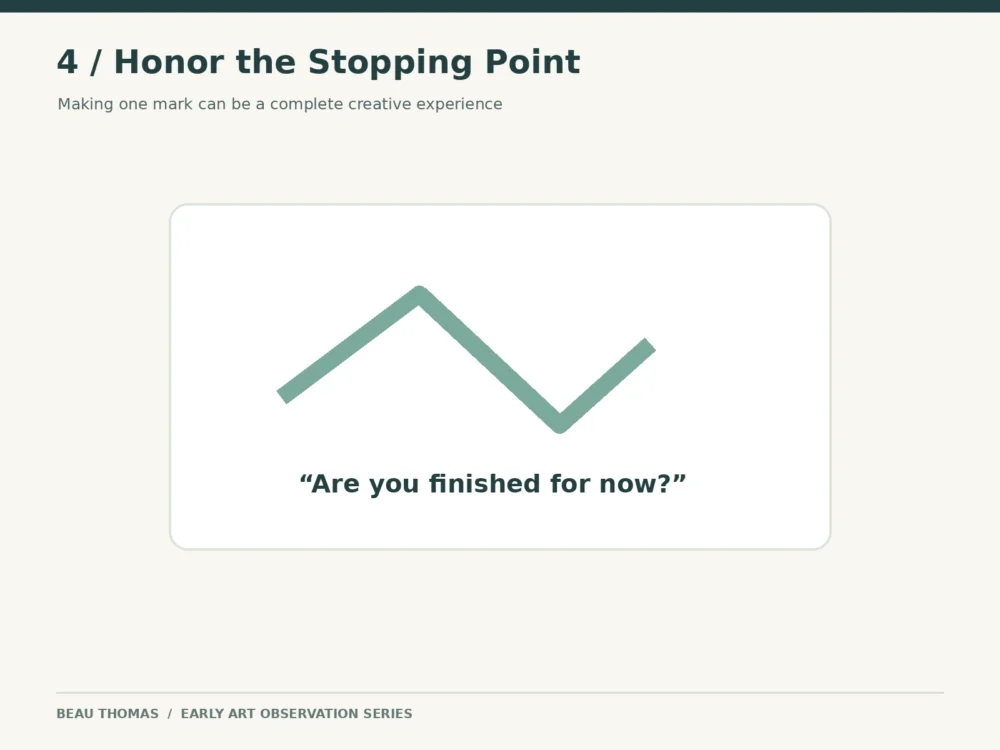
Respect the child’s decision to stop, even after a few marks.
A tiny language toolkit for caregivers
Five responses are worth keeping nearby:
- ‘I noticed you chose that color.’
- ‘You moved your hand all the way across.’
- ‘You tried that mark again.’
- ‘Would you like another sheet or are you finished?’
- ‘Thank you for showing me.’
Each phrase describes, offers a choice, or expresses interest without grading the result.
Parents can also photograph a page or jot down the date and a short observation about the
process, but they need not keep every scrap or turn every session into documentation. What
matters is the child’s experience, not the volume of evidence collected.
What artwork cannot tell you
A child’s marks are not a diagnosis, a test of intelligence, or a dependable measure of
emotional health. Development varies, and a single drawing cannot establish what a child
knows or feels. If you have concerns about development or physical access, speak with an
appropriately qualified professional rather than interpreting the artwork alone. Art can be a
joyful place for shared attention without being pressed into the role of an assessment.
The invitation
The next time a child makes a mark, consider leaving the picture unnamed for a moment.
Watch what they notice. Protect the choices that are theirs. The adult’s job is not to turn early
marks into adult-looking pictures, but to create a safe space in which a child can explore
what marks can do. Sometimes the most generous thing we can contribute is a sheet of
paper, an attentive presence, and the courage to leave the line exactly where it landed.
About the author
Beau Thomas
Beau Thomas is a California visual artist, public artist, art educator, and parent. He
holds an MFA in Studio Art from Mills College.
Portfolio: https://www.BeauThomasArt.com
Instagram: @BeauThomasArt
Cute Easy Drawings – Learn Step-by-step

Free Coloring Pages for Your Inbox!
We’ll never spam you — just fun stuff for you and your little artist. Pinky promise.😊