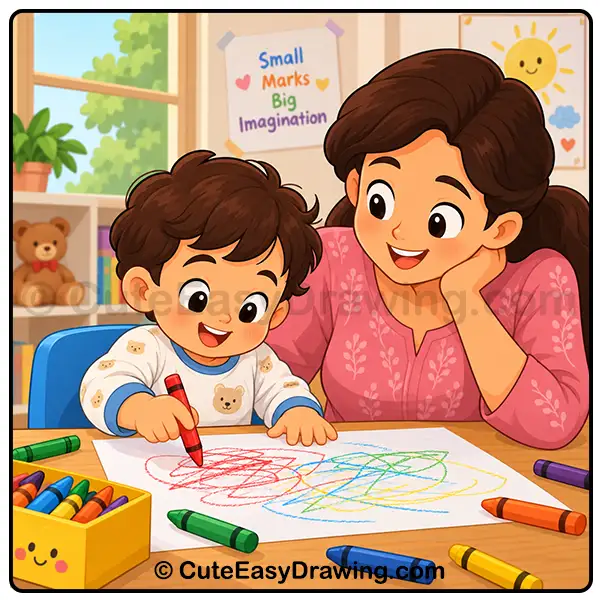
A crayon, a sheet of paper, and a little imagination can keep a child happily busy. For many parents, one of the most memorable moments is watching their child make those first marks on paper. At first, the page may be covered with random lines and circles, but these simple marks are much more meaningful than they appear. They show a child discovering movement, experimenting with tools, and beginning to communicate ideas visually.
So, when should kids start drawing? The answer may be earlier than many parents expect.
Children can begin exploring crayons and other drawing materials from around 12 to 18 months, as long as the activity is supervised and the materials are age-appropriate. Drawing then develops gradually, moving from uncontrolled scribbling to recognizable people, objects, scenes, and eventually more detailed artwork.
Understanding this journey can help parents enjoy each stage instead of worrying about whether a child’s drawings look “right.” Drawing is not a competition. It is a natural part of child development that supports creativity, coordination, communication, and confidence.
Why Drawing Development Matters
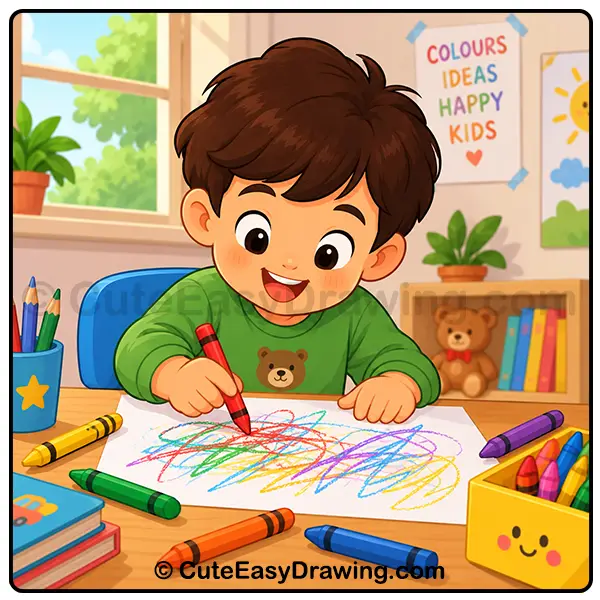
Drawing gives young children an opportunity to explore the world in a way that feels natural to them. Holding a crayon strengthens the small muscles in the hands and fingers. Moving the crayon across paper encourages hand-eye coordination, while choosing shapes and colors requires attention and decision-making.
Early drawing also gives children a visual way to express thoughts and experiences. A picture of a family, favorite toy, or imaginary creature may tell a story that a young child cannot yet explain in words.
Parents who understand drawing milestones can offer suitable encouragement without placing unnecessary pressure on children. A toddler does not need to produce a recognizable picture. A five-year-old does not need to draw realistically. What matters is that each child has opportunities to experiment, practice, and enjoy creating.
When Should Kids Start Drawing?
Children can begin exploring drawing as soon as they are able to safely hold and move a suitable crayon or drawing tool. Around 12 to 18 months, many toddlers become interested in making marks. These first attempts are usually broad movements rather than intentional pictures.
At this point, the goal is exploration. Give your child thick crayons, washable materials, and large sheets of paper. Sit nearby and allow them to experiment with lines, dots, circles, and different amounts of pressure.
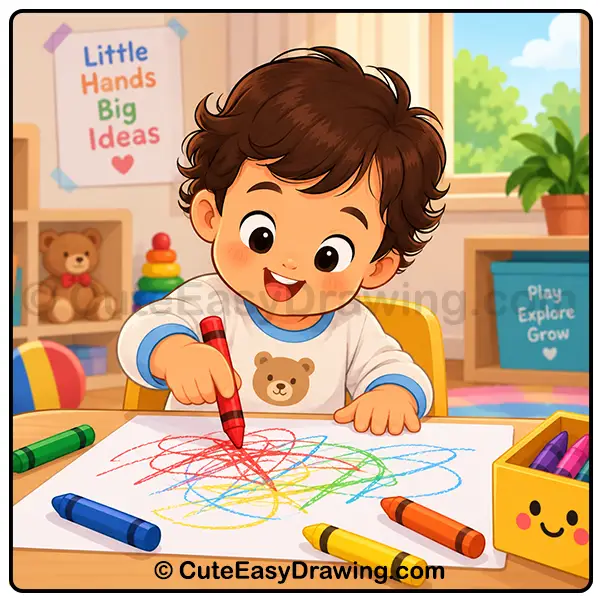
As children grow, their movements become more controlled. They begin to understand that their hand movements create visible results. This simple discovery becomes the foundation for later drawing skills.
The Main Stages of Drawing Development
Stage 1: The Scribbling Years — Around 12 to 36 Months
The earliest stage of toddler drawing is all about discovery. Children often begin with large, sweeping movements that involve the whole arm. Their marks may move across the page without any obvious pattern.
Gradually, control improves. Toddlers may produce repeated lines, circular movements, zigzags, dots, and other patterns. They begin stopping and starting their marks intentionally and may experiment with filling particular areas of the paper.
- Making a silly monster family
- Inventing a new animal mashup (like a cat + donut!)
- Designing your own board game on paper
Scribbling is valuable because it helps children understand cause and effect. Pressing harder may create a darker mark, while moving quickly can create a longer line. Children are also learning how their bodies, hands, and drawing tools work together.
Stage 2: Pictures Begin to Have Meaning — Around 3 to 4 Years
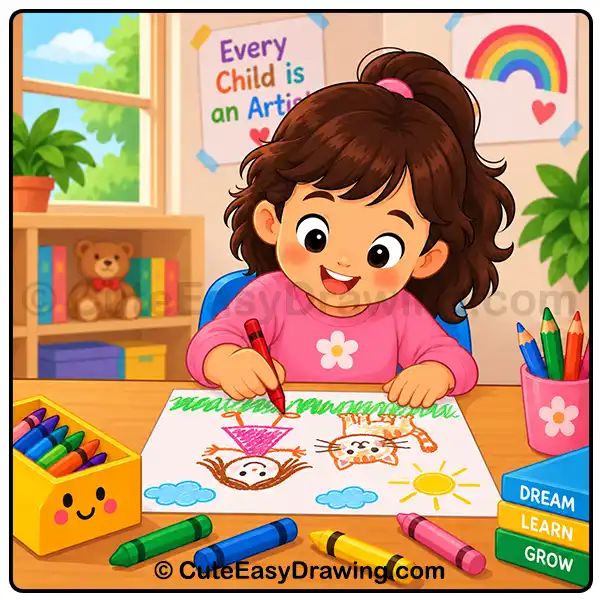
Around the preschool years, children’s drawings often begin to represent people, animals, objects, or experiences. The pictures may still look very simple to an adult, but the child may have a clear idea of what they have created.
This is an exciting stage in preschool drawing because children start connecting symbols with ideas. A circle might become a face, sun, ball, or flower. A few lines may represent arms or legs.
Children may also use size to communicate importance. A favorite person might be drawn much larger than everyone else, while a beloved pet may receive an unusually large place on the page.
Stage 3: More Organized Pictures — Around 4 to 6 Years
As children approach five and six, their pictures often become more organized. People gain additional body parts and facial details. Houses, trees, animals, vehicles, and other familiar objects become easier to recognize.
A four-year-old may draw a person with a head, body, arms, legs, eyes, and hair. By five, children often add clothing details, backgrounds, colors, and objects connected to a simple story.
At this stage, parents can encourage storytelling. Ask open-ended questions such as, “What is happening here?” or “Tell me about this picture.” This allows children to explain their ideas without suggesting what their drawing should look like.
Stage 4: Stories, Details, and Structure — Around 6 to 7 Years
Around six and seven, children’s drawings can become much more detailed. They may create scenes involving several characters and objects, showing relationships between them.
A drawing of a family might include different hairstyles, clothing patterns, facial expressions, furniture, trees, pets, or other details. Children increasingly use pictures to tell complete stories rather than simply showing individual objects.
Their awareness of space also improves. Some children begin experimenting with distance, overlapping objects, and early forms of perspective. Letters and numbers may appear naturally as drawing becomes connected with growing literacy skills.
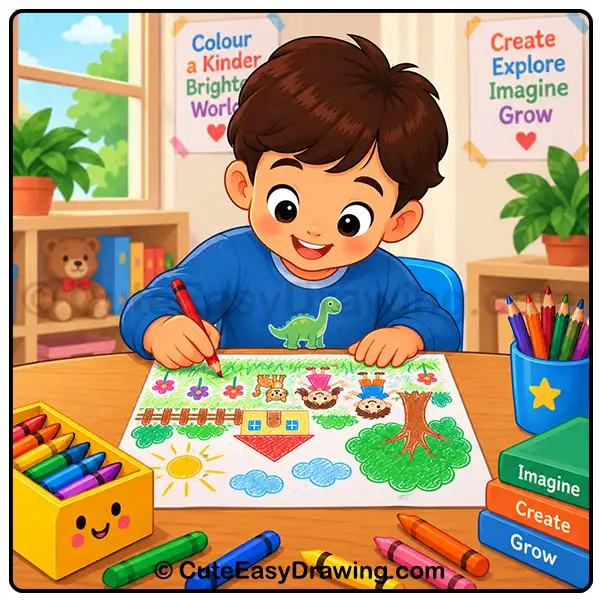
Stage 5: Greater Detail and Self-Awareness — Around 7 to 8 Years
By seven or eight, many children become more aware of proportion, placement, detail, and visual accuracy. Their pictures may contain more organized scenes and repeated visual patterns.
Children may begin comparing their work with pictures they see elsewhere. This can be a positive sign of growing observation skills, but it can also make them more critical of their own drawings. A child may say, “Mine doesn’t look right,” even when their work shows considerable progress.
This is a good time to emphasize effort, observation, and personal style rather than perfection. Some children will become especially interested in drawing, while others will prefer building, writing, music, sports, or other creative activities.
A Simple Drawing-by-Age Guide
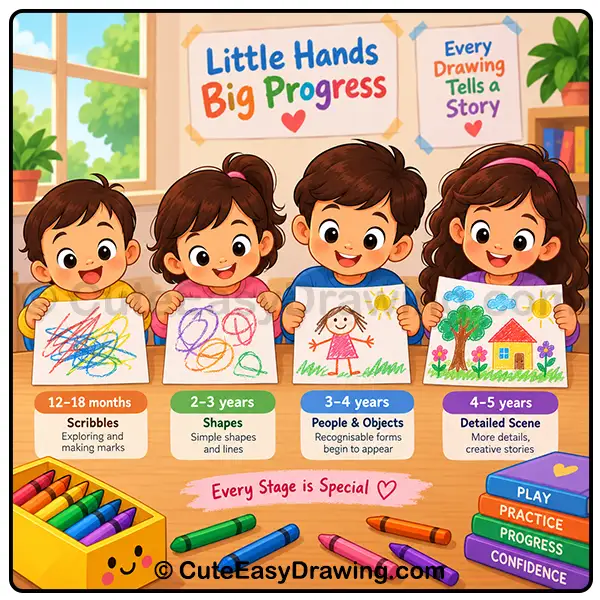
Every child follows a slightly different path, but the following overview can help parents understand common drawing by age patterns:
- Around 1–2 years: Large scribble, dots, lines, and experimental marks.
- Around 2–3 years: Better control, repeated shapes, circles, and purposeful movements.
- Around 3–4 years: Simple people and familiar objects begin appearing.
- Around 4–5 years: More recognizable figures, colors, details, and simple scenes.
- Around 5–6 years: Drawings become more organized and story-like.
- Around 6–7 years: More details, multiple figures, backgrounds, and early spatial awareness.
- Around 7–8 years: Greater attention to proportion, patterns, detail, and visual organization.
These are broad drawing milestones, not examinations. Children can reach them earlier or later and still develop normally.
How Parents Can Encourage Drawing
Keep Materials Easy to Reach
Children are more likely to draw when materials are available. Keep washable crayons, pencils, markers, and paper in a safe, accessible place. Large sheets can be especially useful for younger children because they allow broad arm movements.
Let Children Choose the Subject
Avoid directing every drawing. If a child wants to draw a purple elephant or a house floating in the sky, let the idea develop. Imaginative choices are part of creative growth.
Praise the Process
Instead of focusing only on the finished picture, notice the effort behind it. Comments such as “You added so many details” or “I like how carefully you chose those shapes” encourage children to keep experimenting.
Avoid Comparisons
Two children of the same age may produce completely different drawings. One may enjoy detailed pictures, while another may still prefer scribbling. Comparing them can make art feel like a test.
Make Drawing a Shared Activity
Parents can sit beside children and draw together without taking over. Sharing the activity can turn drawing into a relaxed opportunity for conversation, imagination, and connection.
When Should Parents Be Concerned?
Developmental ranges are flexible, and differences between children are normal. A child may be less interested in drawing while being highly engaged in other activities.
However, parents who have broader concerns about a child’s motor skills, communication, vision, or overall development should discuss them with a pediatrician or qualified child-development professional. Drawing alone should not be used to judge a child’s development.
The most helpful approach is to look at the whole child rather than one picture. Progress over time matters more than whether a particular drawing matches an age-based example.
Conclusion: Let Every Little Picture Count
Drawing begins long before children create recognizable pictures. A few early scribbling can represent a major step in learning how movement, tools, and ideas connect. With time, those marks become shapes, people, objects, stories, and increasingly personal forms of expression.
Understanding when should kids start drawing helps parents replace pressure with encouragement. The important thing is not getting children to draw perfectly at a certain age. It is giving them safe materials, enough freedom, and plenty of opportunities to explore.
Table of Contents
Cute Easy Drawings – Learn Step-by-step

Free Coloring Pages for Your Inbox!
We’ll never spam you — just fun stuff for you and your little artist. Pinky promise.😊